Bedtime Blues: How the UK sleeps
As specialists with 70 years' experience within the sleep and wellness sector, Silentnight wants to understand what is keeping the UK awake at night. We surveyed a nationally representative sample of 2,000 British adults to get a view on how everything from what you eat to where you live affects how much sleep you get on a nightly basis.
Our data shows
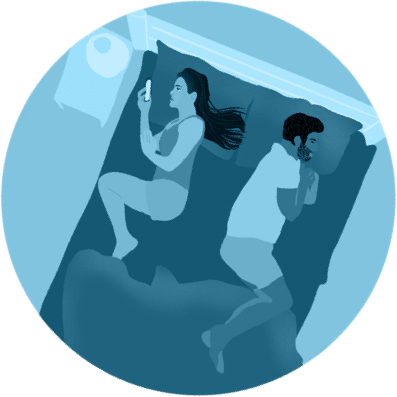
The average night’s sleep in the UK is 6 hours and 17 minutes.

This is 43 minutes less than the minimum 7 hours amount recommended by the National Sleep Foundation.
The average night’s sleep in the UK is 6 hours and 17 minutes.
This is 43 minutes less than the minimum 7 hours amount recommended by the National Sleep Foundation.
What is stopping the nation from sleeping?
Click on each sleeping disorder to discover which UK cities are suffering the most and which the least.

What impacts our sleep?
Click each category below to get more insight into the data and results.
Gender
The data indicates that in general, women are struggling slightly more with various sleep issues across the board, namely:
- 7% of women stated they regularly suffer from anxiety, which is affecting their sleep.
- 29% feel regularly stressed due to not getting enough sleep.
- Half of all women are waking up feeling refreshed less than once a week.

Age
Contrary to popular findings around the correlation of sleep deprivation and old age, our study indicated that, it was those aged 34 and under:
- Over a third of 25 -34-year-olds averaged 5 hours or less sleep a night, making it the most sleep deprived age group of all those surveyed.
- This age group also contains the highest proportion of people suffering from grinding teeth at night, with 1 in 6 saying they regularly experience it.
- Although not the most sleep-deprived, 16-24-year-olds suffered the most emotional effects of sleep deprivation; more than 1 in 3 reported regularly dealing with stress and anxiety, low mood and a lack of motivation as a result of not getting enough sleep.
- 1 in 5 16-24’s year olds also regularly experience insomnia, and 1 in 3 have nightmares at least once a week.

Diet & Eating Habits
To explore the impact of diet on sleep, we asked our respondents what type of diet they followed (including vegan, vegetarian, carb-free, no red meat etc) and compared the results with their overall sleep satisfaction.
- The study concluded that those with a “carb free” diet experienced the most issues with their sleep, with 45% saying they achieved 5 hours or less sleep a night. This was compared to just 23% of those following none of the listed diets (i.e. not regulating what they eat).
- 1 in 4 people on a carb free diet reported regularly suffering from insomnia, twice as many people as those not following any of the listed diets.
- As well as 29% of carb-free dieters suffering regularly from chronic pain at night, 17% also suffer from narcolepsy, compared to only 1% of people who don’t follow any of the listed diets.
- Almost half (49%) of all carb-free dieters regularly have nightmares, and 42% are happy with how much sleep they get less than once a week.
- Adding to this, half of all carb free and vegan dieters regularly suffer from night sweats.
We also explored how respondents’ eating habits before bed affected their sleep routine. Our results suggest that eating your evening meal less than an hour before bedtime causes more issues with sleep, with 1 in 5 people who did this achieving 5 hours or less sleep at night. 1 in 10 people who at eat at that time also reported suffering from insomnia more frequently.

Salary & Profession
The results of our study showed no clear positive or negative correlation between salary earned and quality of sleep. We did find, however, that those in the middle-class salary bracket (£45,000 - £55,000) suffered the most with their sleep:
- 1 in 3 people in this salary bracket reported getting 5 hours or less sleep a night.
- Twice as many people earning this amount suffer from restless leg syndrome than those who earn less.
- 1 in 3 people earning £45,000 - £55,000 also suffer from nightmares at least once a week, compared to just 1 in 10 people who do not work.
Interestingly, those who didn’t work reported some of the highest levels of satisfaction with their sleep, with 56% saying they woke up feeling refreshed.
With the stark rise in shift work, flexible working and the gig economy, we also wanted to learn how the trend towards more irregular working hours is affecting the nation’s sleep:
- More than half (52%) of night shift workers with fixed hours achieve 5 hours or less sleep a day, compared to 20% of daytime workers with fixed hours.
- Those working night shifts were far more likely to experience a range of sleep ailments - 1 in 5 night shift workers suffer from insomnia, chronic pain, shift work sleep disorder, restless leg syndrome and grinding teeth.
- Despite 70% of those who work from home reporting they get over 5 hours of sleep a night, they feel the least satisfied with it, with 72% happy with their sleep less than once a week, and 62% waking up feeling refreshed less than once a week.

Location
Can geographical location and other factors such as population density impact the quality of your sleep? We cut results by city to see how respondents from around the UK feel about their sleeping habits:
- Those living in coastal towns and areas reported getting the best night’s sleep, with only 19% of people averaging 5 hours or less sleep a night in both Brighton and Plymouth.
- 33% of people in Belfast and Cardiff are getting less than 5 hours sleep a night, making these cities the worst sleepers.
- Respondents from Belfast also specifically reported being kept up by several ailments including; insomnia, shift work sleep disorder, sleep apnoea and teeth grinding.
- Nottingham residents were the most likely to snore, with 22% of people admitting to doing this regularly. 1 in 4 people from Nottingham also regularly suffer from chronic pain.
- Contrary to popular belief, Londoners weren’t the least satisfied with their sleep, with more than one in two people in both Edinburgh and Glasgow saying they weren’t happy with their sleep quality in any given week.
- Residents in the north of England were most likely to have their sleep disrupted by things like night sweats and nightmares.
- Respondents from Sheffield reported suffering with nightmares the most, with 27% of people having at least one a week. Manchester, however, came up top for night sweats, with 36% of people regularly experiencing these.

This work is licensed under a Creative Commons Attribution-ShareAlike 4.0 International License.